A study in Tawny – The Graham’s Cellar Master’s Trilogy
‘It’s no use worrying about time’ – Frank O’Hara … who clearly never had to look after Tawny Port.
Time is one of fine wine’s great ingredients.
Few industries – and far fewer in the world of food and drink – deal with something designed to be enjoyed years, possibly decades, after it has been made.
Besides the academic and sensory pleasure, it can be easy to forget – especially for those of us lucky enough to work in the industry – the sheer, ineffable magic of drinking a wine whose grapes were picked years ago.
Something which has slumbered in cask and bottle through the slow, slow, transformative creep of years; its flavours shifting, its textures softening in a metamorphosis from youthful boisterousness into something of richness and breadth, with layers to slowly unpick through long, contemplative hours.
Magic – yes, unquestionably. Wine’s ace in the hole.
And few wines conjure it as compellingly as Single Harvest Tawny Port. Which brings us to the Graham’s Cellar Master’s Trilogy.
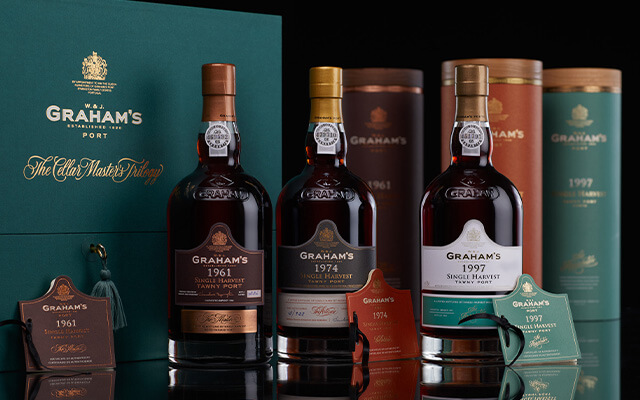
Single Harvest Tawny
Single Harvest Tawny Port is not only one of the great Port styles – it’s one of the most inimitable, distinctive and extraordinary wines full stop.
Not merely in the capturing of a single vintage – but in the paradoxical preservation and transfiguration of that vintage’s essence through astonishing time in cask. Time that almost no other wines could survive – but which burnish the character of Single Harvest Tawny with new-found hues of depth and complexity.
Single Harvest Tawny – as are all styles and ages of Tawny – is a Graham’s speciality. And the Cellar Master’s Trilogy is one of the highest celebrations of that tradition.
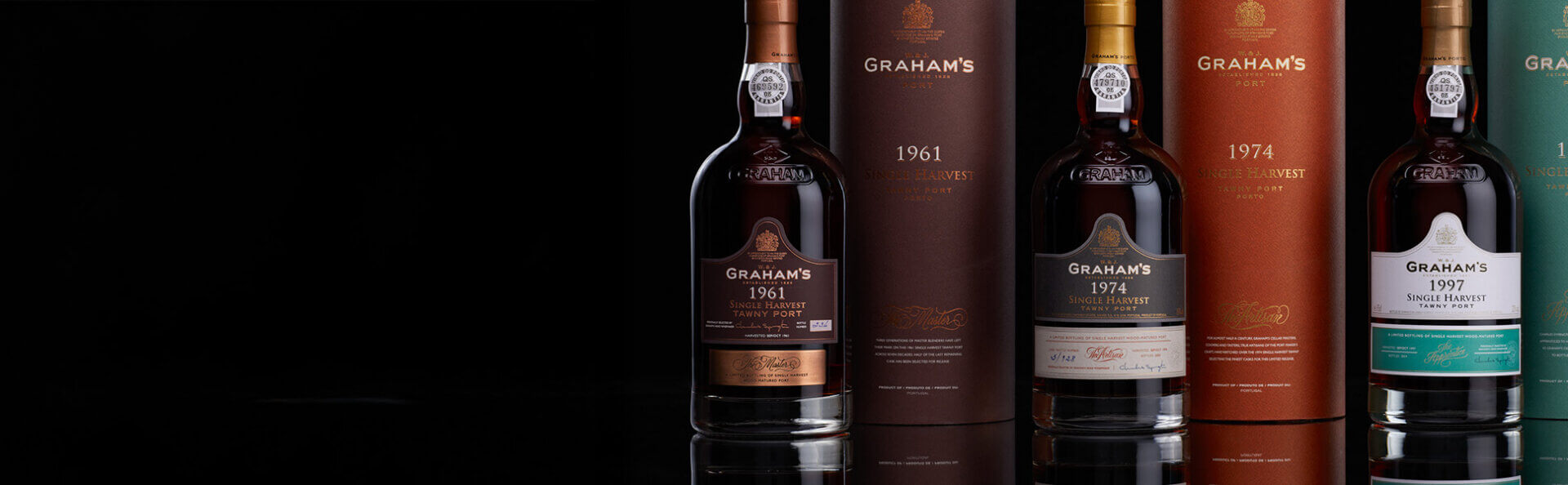
Three unique wines selected from outstanding individual harvest years. All from ‘A’ grade vineyards, selected for their excellence by Head Winemaker and Master Blender Charles Symington, and released in eye-wateringly small batches.
(To be clear, since ‘small batch’ is used to death these days – the sum-total of the 1961 ‘The Master’ came from just half a cask).
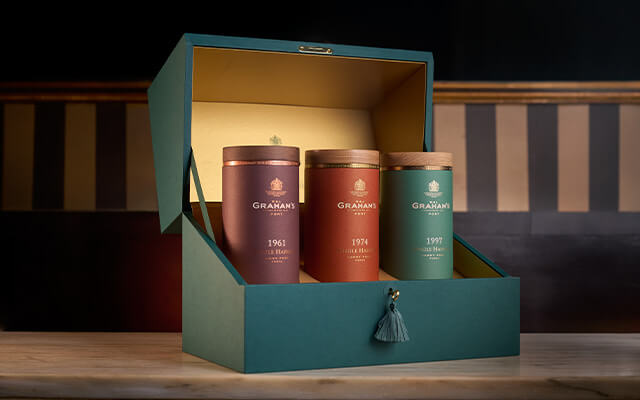
Generational Port making
The trilogy doesn’t merely celebrate three remarkable – and exceptionally rare – vintages. It exists to pay homage to the skills, experience and craftsmanship honed over generations at Graham’s to perfect these Tawny Ports.
Only released every few years, always in a new trio of vintages – only nine cases of the current edition remain.
The Apprentice, 1997. Odd to call a wine almost 30 years old ‘the young one’ of the group, but by comparison with its stablemates it captures the beginning of the journey. Fitting that, at the time of its harvest, Charles Symington was apprenticed to his father, Peter.
The Artisan, 1974. A pivotal year for Portugal, when a coup overthrew the dictatorship, establishing democracy. Due to the political turbulence of the time, Peter Symington chose not to bottle a Vintage Port – despite an exceptional growing year. The 50 years of artisans who have watched over the casks that held this wine have ensured it now enjoys the recognition its quality deserved.
The Master, 1961 – Only half a cask to satisfy the world. Three generations of Master Blenders have watched over it in that time across seven decades. Meticulously chosen by Charles Symington for limited release as ‘The Master’. The essence of an iconic era and a lineage of craft that has stood the test of time.
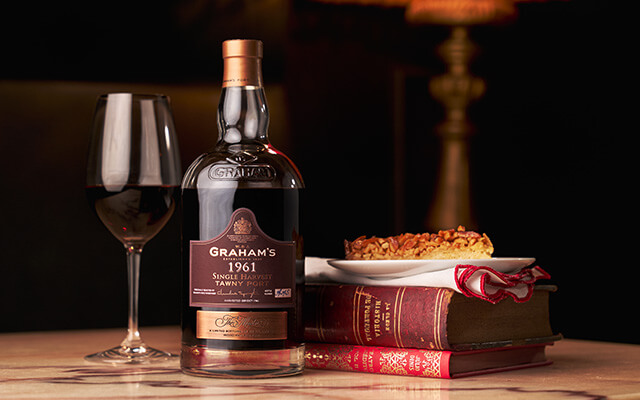
Journey in time by glass
Fells: You’ve talked a lot about vineyards – tell us a bit more about those you work with, and the ways you practice viticulture?
Alice: At Henriot we have about 37 hectares of vineyards that are our own. We are Certified Organic Viticulture – we come to the vine with a terroir approach. We are HVE and we are VDC, which is sustainable viticulture in Champagne – it’s more exigent than HVE. For us, Certification is not the end. It’s just a global philosophy that conduces us to, step-by-step, reduce our impact on the environment and increase the level of quality. Of course we had quality in the past, but climate change is a reality so we need to adapt ourselves to fight climate change and preserve the quality. So we have to work. So that’s why we’re very present in the vineyard – it’s a big part of our job. The biggest part of our human resources are in the vineyard, because we need people to do a good job.
When I joined the house we had this terroir approach, we had this desire to be sustainable – but we wanted to do more. We wanted to think differently, more out-of-the-box, because now we have more tools at our disposal; we have greater scientific knowledge. So we are able to adopt all these practices.
We created a project that is really our way to approach the vine – Alliance Terroir. It’s composed of three pillars, which are what we always think of in our viticulture. The first one is the knowledge of viticulture and terroir. We need to know to be able to take action. This is the principle. So we do a lot of analysis for each terroir; it’s not the same analysis for each one, because so many things are different from one plot of vines to another. We do necessary analysis; everything we do is something we can use and adopt, it’s not something we just do to take pleasure! It’s not just for the sake of science and research – we don’t have a research and development service – we just analyse to adopt the best practices possible.
So we do analysis on the soils. We need to know, for example, exactly the quantity of organic matter you need. To know exactly the texture and structure of the soil; so how do you work the soil? What is your level of humidity – with climate change, with more warm, dry weather it’s beginning to be difficult; even though we have chalk in Champagne, if we have less and less water one day the chalk will not have humidity. So we need to adapt our practices; do we keep the grass, do we work the soil, do we protect the humidity or not?
Stories, insight and of course wine
Stay up to date with the world of wine