A mind-blowing interview with Vilafonté
You don’t expect to hear about repurposed FBI Spyware when you have a chat in this industry … but Mike Ratcliffe is no ordinary winemaker, and his Vilafonté M and C Series, the 2023 vintage of which launched last week, are no ordinary wines.
From fusing out-of-this-world technology with the most loving of hands-on approaches, to the search for the world’s oldest soils, to 100-year-plans (and traditional South African cooking pots) this was quite simply one of the most fascinating half-hour conversations we can remember having.
Far too good for a cutting room floor – so this week we’re spoiling you with the lot.
It’s on our website – or in full below, depending on your preference, but trust us, if you’re half the wine geek we imagine most of our readers are (like us!), this is your must-read for the week.
At which point we’ll shut up and let Mike do the talking. Enjoy.

Fells: Starting with the easy one: please introduce yourself and Vilafonté
Mike: My name’s Mike Ratcliffe; I’m the owner and co-founder of Vilafonté. We planted our first vineyards in 1998 and we’ve been going strong ever since. I have a multifaceted wine industry background, being Managing Director of Warwick for 20 years, working in wineries all around the business in my early years. I also have a consulting business called Wine Business Advisors www.winebusinessadvisors.co.uk which I founded in 2016. We operate, as of last month, on all wine producing continents in the world. Small company, only a small staff, but we do a lot of strategic advisory.
And then, for the last nine years I’ve been Chair of Stellenbosch Wine Routes, which is a body that contains 135 wine producers. And I’m also Chair of a separate organisation called Visit Stellenbosch which is the Stellenbosch tourism bureau, which represents the greater Stellenbosch tourism community.
So yes, I think you could say that wine is in my blood, in my veins! I come from a wine family and I’m building a next generation wine family as we speak.
Fells: Before we get into talking about the wines themselves – can you tell us as much as possible about the place – the vineyard – behind them? Especially with reference to the two distinct soils.
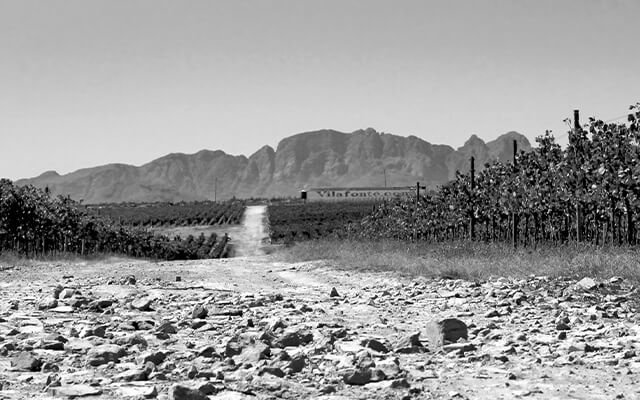
Mike: Vilafonté started as an idea with Dr Phil Freese, my former business partner, ex- Head Winegrower at Opus One and Mondavi. Phil developed a deep insight into the ancient soils of the world and how they impact the greatest wines of the world. And very quickly his research took him not just to Bordeaux, which is not that old, or Napa, which is not old at all, it took him to Africa, where almost all of the oldest soils in the world are. There are many claims around the world in other countries that they have the oldest soils – but they’re confusing soils with continents, which is a big mistake.
So, he came to South Africa, and he realised that of all the oldest documented soils in the world, and specifically in Africa, the oldest of all of them that had been formally documented was a soil type called Vilafontes. And so that’s where the name of the winery originally comes from – it’s the underlying strata into which we plant our grapes. When we started Vilafonté it almost started as an experiment about what might happen if you took the oldest documented soil in the world and planted classic red wine grape varieties into it. I’m not kidding, that’s kind of how it started. The early experiment became a project, a philosophy became a project, and then became a business.Now, here we are today, having developed at least 3 decades of deep understanding of our site, guided by an overarching feeling of gratitude and spirituality.
When we originally planted the vineyard, we planted it for a single wine. And the vision of harnessing the soils was to create literally one single wine from our very, very specific footprint of terroir. But in 2001 and 2002 as we started examining the wines we realised quite quickly that actually, in those early days there were these two expressions coming out of the vineyard. And one of them went on to become the rounder, juicier expression, which is the Series M, and the other one went on to become the more structured and tense, concentrated version and that became Series C.
We are entirely reliant on our very specific soils – since 1998 we have never bought a grape and we have never sold a grape. Every single grape comes from our property, and at our property the soil type is called Vilafonté. Vilafonté is a pure expression of our site, and it’s remarkable vilafontes soils. I have shared a long story to tell you a pretty simple concept!
Fells: Talk us through your approach to viticulture? So much of what you do is almost completely unique.
Mike: I guess we try to fuse cutting edge technology with mastery and the handcrafted nature of the great vineyards of the world. Spirituality can be fused with modernity. Our first secret weapon is that we don’t have a lot of staff turnover. Everybody who works in our vineyard has been there from the start, or at least for a long time. They’re getting a bit older, a bit of grey coming through! Edward Pietersen, our Head Wine Grower was there in 2004 when we started. He knows every single vine, he walks the vineyard every single day, and that’s pretty much how my team roll – we like to be in the vineyard every single day.
In terms of tech, we’ve been industry leaders on many fronts over multiple decades. We were the first winery to import the concept of multispectral, hyperspectral NDVI overhead aerial imaging, but to tell you the truth that was first pioneered by Dr Phil Freese in California, so he was not just the first in South Africa, but the first in the world to do that. It’s a very long story about using the US military and FBI spy technology for spying on the Russian wheat crop! And he brought that technology to South Africa to start ‘spying’ on our particular patch of vineyard, looking for any kind of particular deficiencies in the photosynthetic ability of our vines to absorb the ultraviolet spectrum.
We were also the pioneers in South Africa of something called EM38 Ground-penetrating radar, which I’ve still not heard of anyone else using after all these decades. But it’s using mining technology to map out 12 feet underground into the substrates. Everything from soil densities to soil types to water flows, and that has been invaluable.
We also pioneered a thing in South Africa called Leaf Water Potential Management using a tool called the Pressure Bahm, where we can manage the physical stress of the vines. Which has been adopted by a relatively small number of producers now, but it’s still not everyday. This has been invaluable and perhaps our most powerful tool.
I could go on all day but I’ll just give you one more example – we were the pioneer in South Africa and one of the pioneers in the world of underground irrigation. Even now, and we’ve been going about five or six years on this, I don’t know of anyone else in South Africa using it. I believe that Christian Moueix is using it in Napa and there are one or two other examples of people using it. We have reduced our water usage by 70% and improved the efficiency of phenological management by a crazy amount. You can irrigate your vine and it reacts instantly. So we pioneered the technology but then we decided to open-source it to the industry, so while we own the concept we don’t charge anyone to use it. In fact we’d love more people to use it because it’s just that good.
It’s ultimately about the fact that we are hand-crafted, hand-made, non-mechanised, hand-picked, hand-sorted, hand-crushed – but fusing that human element of the production with state-of-the-art technology.
Fells: You’ve just launched the 2023 M Series and C Series – what was the vintage like?
Mike: We recognised some time ago that 2023 was going to be a controversial vintage. To answer your question directly: it’s an exceptional vintage. It’s really top-notch, and we couldn’t be prouder of the wines. I think it’s a new high-water-mark for Vilafonté.
Haing said that, why is it controversial? Well, we’ve always been a high-density vineyard; we were the most high-density vineyard in South Africa, though I think one or two have surpassed us now. As a result, our ripening curves are relatively steep; our acid-depletion curve is also quite steep. So we tend to harvest long before any of our competitors – and when I say ‘long before’, at a minimum 2-3 weeks before any of similar vineyards are harvesting.
There’s a lot more to it than that, but the reality is that in 2023 we harvested our grapes on the 26th February if I recall – which was slightly later than our long-term average. And we finished harvest, the grapes went to the winery, we were fermenting away – it was wonderful, and good volume. And then, four or five days after we finished harvest a disastrous storm hit South African wine country which lasted for more than a week. Whole roads were washed away, even some vineyards were washed away. So a huge number of our colleagues had a very, very tough time.
It’s a nuanced message – you don’t want to be seen to be gloating or knocking anybody down, but to answer the question appropriately: we acknowledge that we were lucky, and it’s amazing. Some of our most respected competitors are simply not releasing vintages in 2023. Our heart goes out to them. So, there you go.
In terms of the nature of the vintage, it was characterised by very small berries, which was fabulous – great concentration, very high ratio of skins and seeds to flesh and, going back to the vineyard, we have some remarkable ratios. I can’t quote them off the top of my head, but I remember that our leaf-surface-area to berry-mass ratio was exceptional. So that’s another reason we ripen so quickly. We had a lot of green leaves, a lot of photosynthetic material ripening a large number of small bunches. It was good.

Fells: You’ve touched on them already, but talk us through the wines themselves.
Mike: Much riper, and there’s more of them. I heard someone the other day describe the structure of the tannins as ‘Dolce and Gabbana Crushed Velvet’, so go figure! But the wines have this incredible, fine-grained, ripe tannins in 2023, which is something that I think we’re going to be talking about in ten to twenty years from now. Other than that, there’s nothing exceptional in the chemistry; the chemistry is just really good. Given the adversity and tension associated with 2023, the wines have somehow unlocked a spiritual dimension.
Series C has always had a capability to show itself at quite a young age, even given the fact that it’s predominantly Cabernet-based. It gets the most oak; 50-60% new French oak, so you’d think on its release that the wine is going to be chunky, and definitely going to need a lot of time in the cellar. But actually every year it surprises us to the extent that Series C often drinks before the Series M. Not everything in life has to be explained – there can be mysteries – and this is one of the mysteries of Vilafonté! That our Cabernet tends to open up beautifully in the early years. Having said that, I opened a 2005 Series C for Easter that was completely off-the-charts delicious, so the wines are really ageing beautifully.
Fells: This is the first time they’ve been released simultaneously. Why’s that?
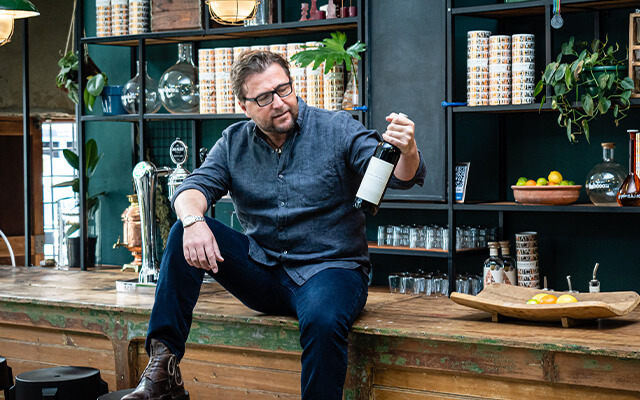
Mike: We’ve had a 30-year masterplan – in fact, if you look at the board behind me, in the top corner, it says the ‘100-Year Plan’. We literally do have a 100-year plan. And right at the top of it, it says ‘Single Wine’. So, we’ve been working at bringing to life the original vision, of making a single wine from our vineyard. And the fact that in 2003, our maiden vintage, the vineyard wasn’t co-operating, and we produced two wines, almost feels in some weird way like it was a compromise! But it’s been a happy compromise, and Series M and Series C, from a South African high-end wine perspective have become relatively dominant in their category of South African fine wine.
But the dream of producing a single wine never died, and in 2019 I got my team to start a process of researching a single-barrel blend of a wine, purely for experimental internal purposes, which would represent the entire vineyard. Rather than having two wines that represent the best of Merlot and Malbec and the best of Cabernet Sauvignon and Cabernet Franc. And in December last year we made the experimental 2025 blend, and I decided that after all these years experimenting, we’d finally cracked it. And so I took what was a pretty monumental decision in the life of Vilafonté to make the call that the 2025 will be the first vintage of a new wine which will simply be called ‘Vilafonté’.
That’s not as crazy as it sounds, because everyone likes to launch a new wine, but actually it is monumental because Series M and Series C will be retired – that’s the end of the road for those two wines. With respect and love. So from the 2025 vintage, which is still in barrel, at some point in 2028 which is still to be announced, we will release the final iteration of the Vilafonté vision, which will be a single wine called Vilafonté.
Going back to your question about why we are doing a single release of the 2023s – there’s a lot of planning that goes into the release of this wine and so we decided that we needed to start moving in the direction of ageing the wine longer in bottle. So the new wine will have 6-12 months longer in bottle before it gets released. We started by moving our Series C release date from November to April, and next year we’ll probably release a little bit later – April or May – but that will hopefully get us into the position where we will be ready for at least 14 months before we start shipping wine for the Northern Hemisphere. And by the time the 2025 comes out, it’ll be shipped around July-August, so ready in the Northern Hemisphere for Christmas 2028. And that will have been a four-year-plan to extend the release date of our wines by an entire year.
Fells: Vilafonté has now been around for almost 30 years. How have things changed in that time? How have you seen winemaking in your region and South Africa more broadly change in that time period, especially in your role as Chair of Stellenbosch Wine Routes?
Mike: Zooming out first to the broader industry, 30 years ago the South African wine industry didn’t have that much of an identity. It was just emerging from 40 years of apartheid sanctions and boycotts. Which admittedly were very successful and necessary in ending apartheid, so hats off to that. But at the same time, for four decades, the wine industry was isolated. The winemaking culture, the globalisation of the wine industry didn’t exist in South Africa. And so the wines weren’t very good at all.
What’s happened over the last three decades is quite remarkable. South Africa has, firstly, acknowledged weaknesses and deficiencies in the quality. Secondly, took some time to start addressing those. It probably took ten, fifteen, even twenty years to start getting back to world standards. But then the momentum didn’t stop and now there are several South African wines which are competing fairly comfortably with the greatest wines in the world. And I don’t think that momentum’s stopping, because there’s also a can-do attitude in South Africa which builds it, and it continuously gets embraced by the next generation, which is super-exciting.
Zooming in to what’s happened at Vilafonté, one of our greatest strengths is that Zelma Long and Dr Phil Freese spent the ‘70s, ‘80s and ‘90s in California at the time when California was trying to find its identity. And where California started progressing and where UC Davis started developing its viticulture and oenology. And they went through that process for three decades in California, up to the point where California had identified itself. And then they moved to South Africa and had to start it all again – but were somewhat experienced in doing it!
The greatest strength of Vilafonté is that in any experiments, the most successful are the ones which have the fewest variables. If you change everything you can never work out what the results are, and so from the very first day at Vilafonté it’s been the same site, the same vineyard, the same people, the same winemakers. Nothing has changed. There’s been no rosé popping out, no sparkling wine. It’s been an absolute focus for almost three decades. And as a result of that, with so few things changing, when we do experiment, we can truly gauge what it is that’s good.
So, whilst the industry has gone from strength to strength, all of our growth and improvement at Vilafonté has happened beneath the surface, as opposed to being broadcast out to the public. If you look at a bottle of 2003 Vilafonté and a bottle of 2023 Vilafonté they look identical. There’s no change whatsoever. Meanwhile the wines are technically superior, the vineyards are older, the wines are rating higher, total acidities, there are lower alcohols – but more importantly lower ethanols. The wines are superior. And I often say to our clients that we think the greatest wines that we will ever produce are most likely ahead of us, not behind us. I think that speaks to the ongoing evolution, and the fact that in my little company of seven senior management we’ve got three PhDs and five Master’s Degrees.
Fells: I guess harvest 2026 has come and gone very recently for you. What’s it looking like?
Mike: In short, it was lovely. I always like to look at the chemistry of the fruit – it’s all very romantic to say ‘oh it looks pretty’, but looking at the chemistry is key. What’s your acidity, what’s your sugar? So the chemistry was beautiful, the berry quality was excellent.
We did a lot of sorting out on the sorting table, but our sort-out percentage was extremely narrow, which means that all the grapes that came into the winery were very high quality and uniform, which is great. We call it a very low berry variability, which is a key factor for us. In general, we’re delighted. Good volume, good quality.
But if you’re looking for a couple of angles to explain 2026, in early January there was mild panic in the wine industry because there was a significant heatwave, and a lot of vineyards literally gave up and died. And that’s when our sub-surface irrigation really proved itself. Because, you know, you just switch it on a little bit, give the vine a little sip, and it’s happy. It can weather any kind of heatwave as if it doesn’t exist – vines are pretty hardy in that way.
So that was the first thing, and then the second thing, sadly, is that although it wasn’t nearly as significant as 2023 and certainly doesn’t happen very often, is that at the end of February, again, there were three days of rain. Which didn’t impact us at all, but although it wasn’t similar to 2023 there were people who had to delay their harvest two or three weeks to allow their berries which had picked up a lot of water and swollen to reduce in size and concentrate again. Which is really not optimal for winegrowing.
In general, I’m delighted with the 2026 harvest.
Fells: And lastly, can you talk us through this 100-year plan?
Mike: Well, our master plan is already eight years old, so technically now it’s a 92-year plan! So there’s a traditional cooking pot in South Africa called a poitjie (poy-key). It’s a cast iron cooking pot that has three legs. Internally, we refer to our 100-year plan as a seven-legged poitjie. A big pot we mix things into, but with seven legs that keep it from falling over! I mentioned the first leg, which is the vision to move to become a vineyard represented by a single wine, which we’re quickly moving towards.
The second poitjie leg is our yeast isolation project and we have joint ventured with the University of Stellenbosch. We had been co-operating since I think 2017 with Opus One in California. Arlene [Mains], who is Head Winemaker for Seriously Old Dirt, did her Master’s Degree in Wine Biotechnology and her thesis was about ‘evaluating the Impact of Yeast Co-Inoculation on Individual Yeast Metabolismand Wine Composition’ which was quite topical for our project.
So, together with Winemaker Chris de Vries they have been heading up a yeast isolation project of actually isolating Vilafonté yeasts. Because we have never used commercial yeast; we always allow the native yeasts on the grapes to start the fermentation. But there’s quite a lot of risk involved, so what we’ve decided to do is start isolating the yeasts from the fermentation that we pick up in our own vineyard that we like – and start to isolate the different flavour profiles and qualities that those yeasts bring. This vintage, 2026, was the first year when we inoculated our fermentations – but we inoculated them with our own native yeasts that we’ve spent almost half a decade isolating. So this will accelerate over the coming years as we get smarter and better and as we isolate those yeasts more.
The third potjie leg is people. Making sure that our team is locked in, fully motivated and that they have started to feature and are all independent, so that’s key. ‘People’ also refers to another leg, which is ‘Succession’: to make sure that there are at least members of the family who are intelligently and coherently being brought into a longer-term education programme so that when and if they decide they want to participate in being the next generation that they’re suitably qualified.
The fifth leg of the poitjie is that we are in the process of creating our very own clone – and possibly clones – of Vilafonté. We are four years into a process called the Massal Selection (French: sélection massale) of isolating vines in our vineyard that we think are performing at very high quality, taking cuttings and propagating them together with Vititec and Vinpro. In about 2028 we will plant our first vineyard using Massal Selection – and that will be a Vilafonté clone. Which we will hold quite tightly.
Then the second-last potjie leg is very simple. I call it ‘Brand Home’. We’ve spent three decades being closed to the public, having no tourism, staying specialised and focussed. We don’t have a tasting room; and certainly no restaurant, nothing like that. There’s no white wine, no sparkling wine – we’re hyper-focussed. But the long-term view is that we will have a Brand Home. We’ll plan to acquire a property and build it, but it’s going to happen in the next five years – I made an offer on a property last year and they turned me down, but we are in it for the long-term! The wheels are turning.
And the final potjie leg is energy and sustainability. We’re very far advanced on that; we’re off the grid from an electricity point of view. We haven’t pursued any certifications, but we operate and have always operated on organic principles which is guided by our core philosophy of minimal interventionism. Across the board, everything from packaging to our viticulture is focussed around energy and sustainability. Even the irrigation system – that’s reduced our water usage by 70%, and we’re managing our moisture just as much – just not wasting it.
So that is a simple summary of the seven legs of the Vilafonté 100-year plan. It’s eight years old already – but the wheels keep turning.
Stories, insight and of course wine
Stay up to date with the world of wine